
To get stronger, it takes consistency over time. Just one workout, or one week of increased activity won’t make a difference long term. Strength training is often grouped in with medications, when honestly it should be thought of in the same narrative of brushing your teeth or even drinking water.
Why Exercise Is Important for Overall Health and Well-Being
Some people call the muscular system one of the most important organs in the body. That framing isn’t an exaggeration. It’s a way of saying that your muscles aren’t just there for lifting things or looking a certain way.
Whether you’re recovering from a stroke or running a marathon, strength plays a tremendous role in your performance. The best part about your muscles is that you have complete control over their function. The work you put in adds up over time.
You have the ability to maintain and improve your strength as you age.
People who are insufficiently active carry a 20% to 30% increased risk of death compared to people who are sufficiently active, according to the WHO. The NHS puts it another way: regular exercise can lower your risk of early death by up to 30%. Those two numbers are pointing at the same thing.
The best outcomes of exercise are often the things that don’t happen. That’s what makes the importance of exercise so hard to see and so easy to underestimate.
A lot of clinicians jump to motivating the patient to fit in very specific forms of exercise into their routine. In reality, many patients need a first step that comes way before that optimal recommendation.
A Detailed List of How Exercise Positively Affects Overall Health
Exercise doesn’t work on one system at a time. It works on all of them at once. Here’s what the evidence actually shows.
Heart Health and Cardiovascular Disease Prevention
The WHO, CDC, NHS, and Harvard Health all link regular physical activity to a reduced risk of cardiovascular disease. The consistent adult benchmark across those sources is at least 150 minutes of moderate-intensity physical activity per week. That’s about 22 minutes a day.
That number isn’t arbitrary. It’s the threshold where the evidence shows meaningful protection against heart disease, stroke, and related conditions.
How Does Exercise Improve Mental Health?
Running 15 minutes a day or walking for an hour may reduce the risk of major depression by 26%, according to HelpGuide citing a 2019 Harvard T.H. Chan School of Public Health study. The WHO and MedlinePlus both report improvements in depression, anxiety, stress, and cognitive function with regular physical activity.
Mental health benefits aren’t secondary to the physical ones. They show up fast, and they’re parallel.
Strength training has a tremendous impact on your energy, your health, and your overall life satisfaction. That’s not motivational language. It’s what consistent movement actually produces.
Benefits of Exercise on Depression and Anxiety
The mental health case for exercise is specific. It’s not just that people feel better in a vague sense. Depression symptoms reduce. Anxiety symptoms reduce. Cognitive function improves. These are documented outcomes, not side effects.
The mechanism matters too. Exercise changes brain chemistry. It doesn’t just distract you from what’s hard.
Metabolic Health — Blood Sugar, Weight, and Diabetes Risk
MedlinePlus and Harvard Health both cite blood glucose control and healthy weight management as direct benefits of regular exercise. From working to lose weight to addressing high blood pressure or diabetes, strengthening can play a major role in improvement.
This isn’t about aesthetics. It’s about how your body processes fuel and manages chronic disease risk.
Cancer Risk Reduction
Physical activity lowers the risk of developing at least eight types of cancer, according to the CDC. That’s a direct, factual statement from a major public health authority.
It doesn’t require elaboration. It requires action.
Bone Strength, Aging, and Long-Term Function
The WHO and NHS both document benefits for bone health, motor development, and healthier aging. Harvard highlights blood pressure, inflammation, and bone strength as specific markers that improve with regular exercise.
You have the ability to maintain and improve your strength as you age. That’s not optimism. That’s physiology.
The goal isn’t to perform at 25 forever. The goal is to keep your body functional and resilient for the life you want to live at every age.
The research is there, exercise improves your health. The most difficult aspect is finding sustainable consistency. That’s exactly what we do at The Public Wellness Project.
Recommended Amount of Exercise by Age
The adult benchmark is clear and consistent. At least 150 minutes of moderate-intensity physical activity per week. That comes from the WHO, CDC, Harvard Health, and the NHS independently arriving at the same number.
The WHO has set a global target of a 10% relative reduction in adult and adolescent physical inactivity by 2025, and a 15% reduction by 2030. Those targets exist because 31% of adults and 80% of adolescents currently don’t meet recommended activity levels. Those aren’t bureaucratic goals. They’re signals of how far behind we are as a population.
For strength training specifically, 2 to 3 times per week is a realistic and meaningful starting target. That’s where the long-term health impact begins to accumulate.
How to Reap the Mental Health Benefits of Exercise
Mental health benefits from exercise aren’t something you work up to after months of consistency. They’re more immediate than that. Mood, energy, and stress response shift relatively quickly once movement becomes a regular part of life.
Strength training has a tremendous impact on your energy, your health, and your overall life satisfaction. That connection between physical effort and mental state is real and documented.
The non-negotiable variable is consistency. One session helps. Continued repetitions over time are what produce the long-term impact on your health.
How to Build an Exercise Plan Around Strength Training
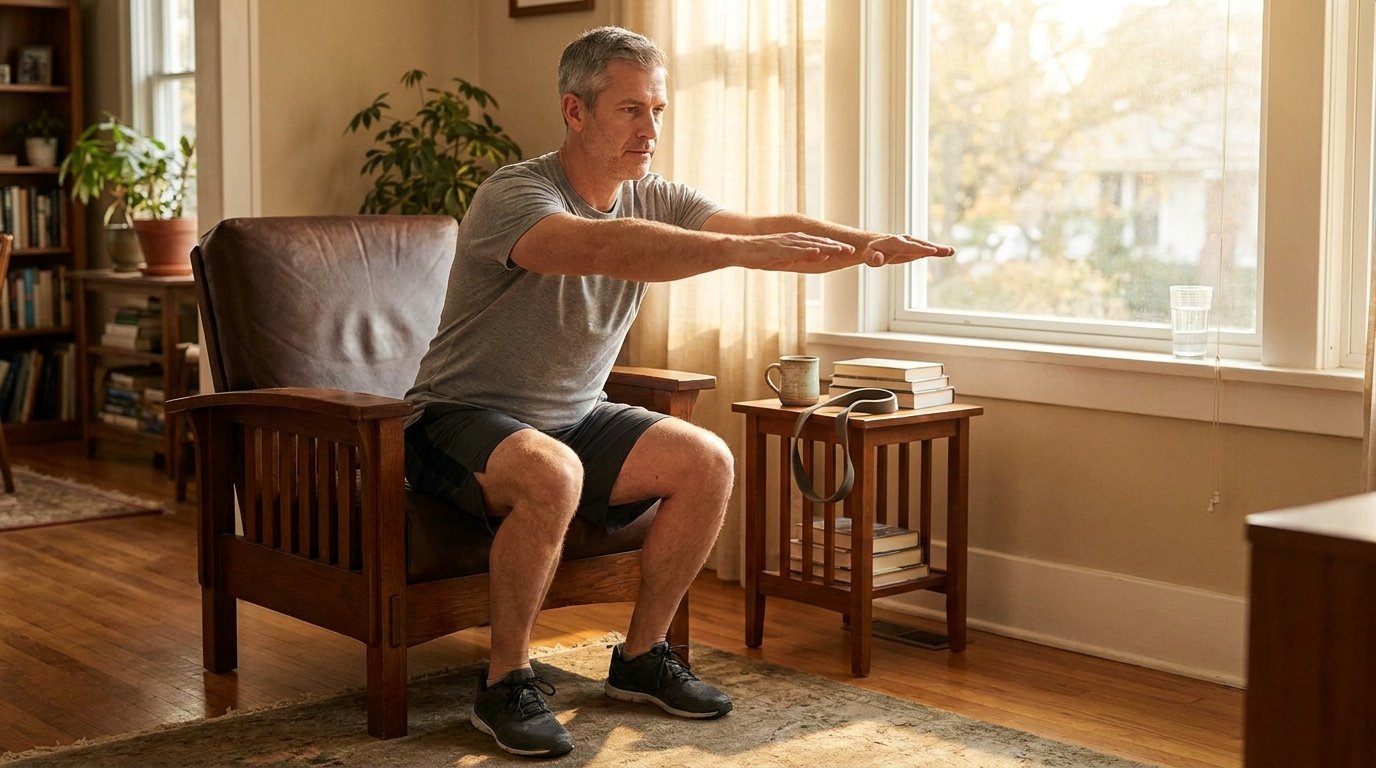
Strength comes from progressive activity that challenges your muscles over time. You complete a resistance movement — like standing up repeatedly — and then progress to more repetitions or add weight to improve the endurance and strength of your muscles.
That’s called progressive overload. It allows your muscles to be challenged, then recover, then grow back stronger for the next time you complete the activity.
You don’t need a gym to start. You need a movement and a reason to repeat it.
The hardest part about strength training is figuring out how to keep it consistent in your life. One session is helpful. But your muscles need continued repetitions over time to have the long-term impact on your health. That’s not a warning. That’s just how the biology works.
I always start with the question: What is your plan to do this on your own? This question serves so many purposes. First, it implies that this is part of their journey, breaking the frame of “do it because I told you so.” It also allows them to set the starting point, or even say “I don’t know,” which is even more helpful information. This moment allows you to problem solve together.
Overcoming Obstacles to Reap the Benefits of Exercise
The hardest part about strength training is figuring out how to keep it consistent in your life. That’s the real obstacle. It’s not the exercise itself.
One session is helpful. But your muscles need continued repetitions over time to produce the long-term health impact that makes any of this worth doing. That gap between knowing and doing is where most people get stuck.
31% of adults still don’t meet activity recommendations despite the fact that the evidence is everywhere and has been for decades. That’s not an information problem. It’s a consistency problem.
How often do you strength train? If it’s less than 2 to 3 times a week, that’s the gap worth closing. Not with guilt. With a plan that actually fits your life.
The CDC estimates that 110,000 deaths per year in U.S. adults ages 40 and older could be prevented if moderate-to-vigorous physical activity increased. That number is preventable. The path to preventing it is consistent, progressive movement — not perfection.
The most difficult part is starting. Make the first step as easy as possible. Go sit in your car in the gym parking lot, go walk on the treadmill for just 10 min. Start by getting your foot in the door to start and see where it goes from there.
Take Our Free Daily Health Audit
How often do you strength train? If it’s less than 2 to 3 times a week, the first step is getting clear on where you actually stand right now.
The Daily Health Audit is free. It’s the starting point for building a plan that fits your real life — not an ideal version of it.
Take Our Free Daily Health Audit and find out exactly where to begin.
Be well.