
By Luke Alley, PT, DPT | Doctor of Physical Therapy & Health Coach
Your Knees Are Keeping Score
Your knees are a horrible joint. They don’t have a lot of support on their own. The biggest support structure is the muscles in your legs. It’s about their strength, but also how well they all work together. Your knees are one of the joints in the body that has the most benefit from consistent strength training.
Here is the truth: most people do not think about their knees until they hurt.
And by the time they hurt, the problem has usually been building for months — sometimes years.
That is the gap. The space between feeling fine and actually being fine. Between what your knees can do right now and what they will be able to do five, ten, or twenty years from now.
This post is about closing that gap. Not with a list of exercises you will forget by next week. With a real plan. One built on evidence, experience, and the kind of habits that actually stick in real life.
Whether your knees feel great or they have been quietly complaining for a while, this is for you.
Why Your Knees Are Already Under Pressure
Your knee is a hinge joint. It sits in the middle of your leg and absorbs force from two directions — from your hips and core above, and from your ankles and feet below. When anything in that chain is weak or stiff, the knee takes the hit.
That is why knee pain is rarely just a knee problem.
Weakness in your quads, hamstrings, glutes, and calves shifts load directly onto the joint. Over time, that adds up. Pair that with long hours of sitting, repetitive impact without recovery, and no flexibility work — and you have a recipe for trouble.
Body weight plays a big role here too. Research shows that extra weight multiplies the stress placed on the knee joint during movement. Even modest changes in weight can make a meaningful difference in how your knees feel day to day.
When I say that your knees keep the score, I mean that your knees take the brunt of the work. They are highly impacted when the foundation for your health isn’t there.
The good news? Most of these factors are within your control. That is what the rest of this post is about.
The 150-Minute Rule: Movement Is Medicine
The research is clear. Aim for at least 150 minutes of moderate-intensity exercise per week, spread across four or five days. That includes both aerobic movement and resistance training.
Think of this not as a goal to hit on your best week. Think of it as the minimum your joints need to stay healthy.
The best news? You do not need to punish your knees to hit this target. Low-impact movement works. In fact, for most people, it works better.
Low-Impact Activities That Protect and Strengthen Your Knees
- Swimming — Almost zero compressive load on the joint. Great range of motion. One of the best options if you are dealing with pain right now.
- Cycling — Builds quad strength and cardiovascular fitness without high-impact force on the knee.
- Walking — Underrated and underused. Consistent walking builds cumulative joint health over time.
- Yoga and Pilates — Improves flexibility, balance, and posture. All three protect the knee from overload.
One important note: if your knees are already uncomfortable, start gradually. Do not try to go from zero to 150 minutes in a week. Build up slowly. The joint needs time to adapt.
The Bulletproof Knee Protocol: Exercises That Actually Matter
This is where most articles give you a generic list and send you on your way. We are going to do this differently. Each exercise below has a purpose. Know the why, and you will actually do the work.
Strength Exercises
Squats
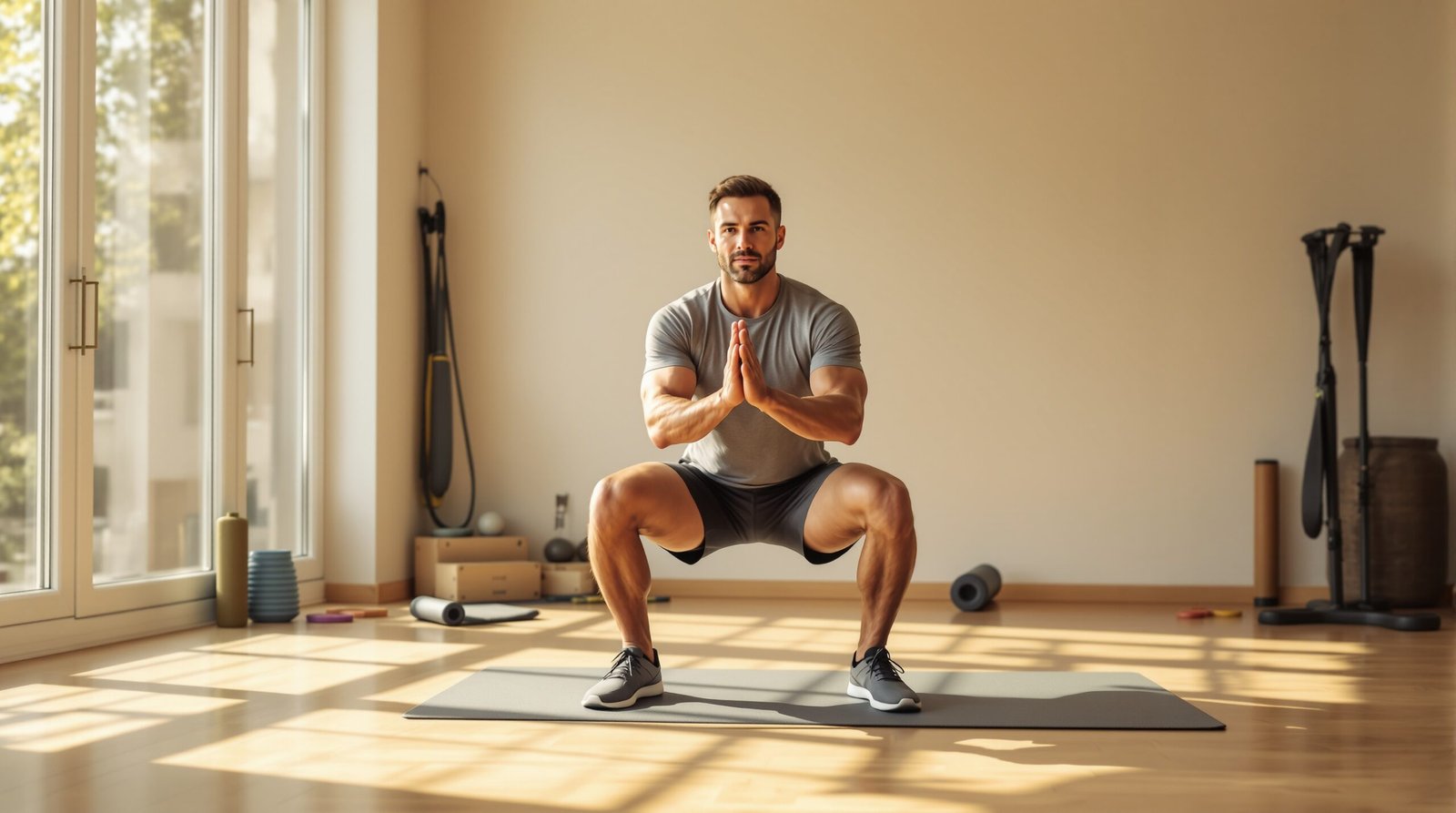
Squats are one of the most effective exercises for building the muscle support your knees need. Lower your hips about 10 inches — as if you are sitting back into a chair — hold for 5 seconds, then stand back up. Aim for 3 sets of 10 repetitions, four to five days per week.
Do not chase depth. Chase control. A shallow, controlled squat is far more valuable than a sloppy deep one. If you need help with form, use a chair behind you as a guide.
Straight-Leg Raises
This one is a staple for a reason. Lie on your back, keep one leg straight, and raise it 6 to 10 inches off the floor. Hold for 5 seconds. Lower slowly. Do 3 sets of 10 repetitions, four to five days per week.
Why it works: it strengthens the quadriceps without putting any load on the knee joint itself. If you are dealing with active pain, this is a great place to start.
Bridges
Lie on your back with your knees bent and feet flat on the floor. Press through your heels and lift your hips toward the ceiling. Hold briefly, then lower with control.
Bridges target your glutes and hamstrings — the posterior chain that protects your knee from forward shear forces. Weak glutes are one of the most common hidden contributors to knee pain.
Calf Raises
Stand near a wall for balance. Rise up onto your toes, hold, then lower slowly. You can also do heel-to-toe raises for added balance work.
Your calves are part of the support structure beneath your knee. Strengthening them helps distribute load more evenly through the entire leg.
Monster Walks (Lateral Band Walks)
Place a resistance band just above your knees. Stand in a slight squat position and walk sideways, keeping tension in the band throughout.
This activates the gluteus medius — the hip muscle that controls how your knee tracks during movement. When this muscle is weak, the knee tends to cave inward, which leads to pain and wear over time.
Lunges
Lunges build single-leg strength, which is exactly what your knees need for real-life movement — walking, climbing stairs, getting up from the floor. Keep your front shin as vertical as possible and make sure your knee tracks over your second toe.
Flexibility and Mobility Work
Most people skip this part. That is a mistake. Tight muscles pull on the knee from every direction. Releasing that tension is not optional — it is essential.
Quadriceps Stretch
Stand near a wall, bend one knee, and hold your ankle behind you. Hold the stretch for 30 to 60 seconds. Do 2 to 3 repetitions per leg, four to five days per week.
Tight quads pull the kneecap upward and create friction in the joint. This stretch is simple, and it matters more than most people realize.
Hamstring Stretch
Sit on the floor with one leg extended. Reach toward your foot and hold. You can also do this lying on your back with a towel or strap around your foot. Hold for 30 seconds and repeat.
Lying Knee Bend and Seated Knee Extension
These gentle range-of-motion exercises help maintain flexibility in the joint itself. Hold the bent and straight positions for 5 seconds each, and repeat 10 times per leg. These are especially useful if your knees feel stiff in the morning or after sitting for long periods.
Hip Flexor Stretch
Kneel on one knee with the other foot forward. Shift your weight forward gently until you feel a stretch in the front of the hip of the kneeling leg. Hold for 30 seconds.
Tight hip flexors tilt the pelvis forward and change how load travels through the knee. Releasing them is one of the most overlooked steps in knee care.
The Injury Prevention Playbook
Knowing how to improve knee health also means knowing how to avoid making things worse. Here is what the research consistently points to:
- Treat injuries promptly. Ignoring a minor knee injury is one of the fastest ways to turn a small problem into a chronic one. Do not wait until it is debilitating.
- Wear appropriate footwear. The shoes you wear affect how force travels through your knee with every step. This is not a small detail.
- Avoid pushing through pain. There is a difference between muscle fatigue and joint pain. If an activity causes sharp or worsening knee pain, stop. Work around the joint, not through it.
- Build gradually. Whether you are starting a new exercise routine or returning after time off, progressive loading is the key. Joints adapt more slowly than muscles. Give them time.
- Know when to see a professional. Persistent swelling, a feeling of instability, pain that changes the way you walk, or pain that wakes you up at night — these are signs to get evaluated by a physical therapist or physician.