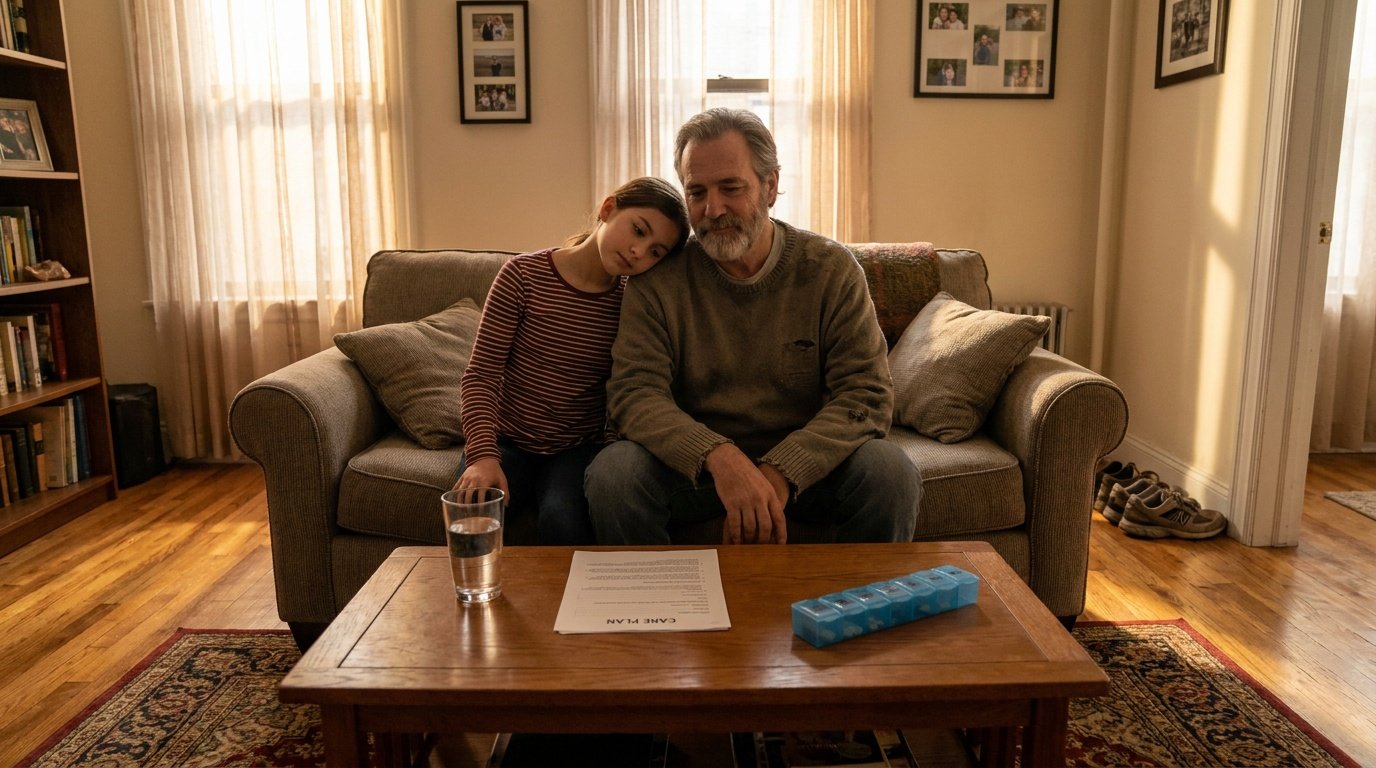

- Continuity of care means one connected health plan that follows you across every provider and every single visit.
- There are three types: informational (sharing your records), management (coordinating your care plan), and relational (keeping the same provider relationship over time).
- A study across nine countries found patients with consistent provider care had an 81.8% lower chance of dying. That number is real.
- Fragmented care, jumping between disconnected providers with no shared plan, is directly tied to worse outcomes in chronic illness.
- The biggest gap is not the plan itself. It is what happens between appointments, at home, in daily habits. Health coaching fills that gap.
[Table of Contents]
What Is Continuity of Care?
Continuity of care is the way your health plan stays connected across every provider, every visit, and every gap in between, built on three distinct types: informational, management, and relational.
Informational continuity means your records, your history, and your test results follow you from one provider to the next. No starting from scratch every time you walk into a new office.
Management continuity means every provider working on you is pulling from the same plan. Nobody is steering in a different direction without knowing it.
Relational continuity means you keep seeing the same provider over time. They know you. That relationship builds real trust.
A patient who sees three different specialists with no shared record gets three different plans. Nobody is steering the whole ship.
That breakdown is exactly what strong patient adherence strategies are built to prevent, because a good plan that nobody follows is not a plan at all.
What Is the Primary Goal of Continuity of Care?
The primary goal is to make sure no gap exists between your providers, your plan, and your daily health actions, and according to continuity reduces care fragmentation to keep healthcare safe, cost-efficient, and high-quality.
Providers catch problems sooner when they have the full picture. Fewer repeat tests. Fewer duplicate prescriptions. Less wasted money.
Patients feel less lost. They trust the process more. They stick to the plan longer.
The goal is not just coordination at the clinical level. It is also what happens at home, every single day.
Sticking to a health plan lives in the connection between what matters to the patient and what the provider is actually recommending. When those two things line up, people follow through. When they do not, the plan sits on the counter like a piece of paper nobody reads.
Why Is Continuity of Care Important? The Mortality Data Is Hard to Ignore
A study across nine countries found that patients who received continuity of care with the same medical provider had an 81.8% reduction in mortality compared to those who did not.
That is not a small number. That is the difference between being alive and not being alive.
Separately, research published in the BMJ demonstrated a clear association between higher continuity rates and reduced all-cause mortality, a finding that has held up across multiple reviews since 2018.
A 2023 systematic review found a significant link between fragmented care and worse outcomes in chronic illness management. Fragmented care is not just inconvenient. For someone managing high blood pressure, diabetes, or heart disease, it is genuinely dangerous.
In inpatient rehab, the patients with the clearest, most connected care plans between their hospital team and their home life were the ones who did not end up back in a hospital bed six months later. The data and the real-world experience say the same thing.
What Obstacles Stand in the Way of Continuity of Care?
A person leaves a specialist’s office with a printout. Their primary care doctor never gets a copy. Their physical therapist is working off notes from three months ago. That is the obstacle, and it happens constantly.
Provider turnover is a big one. When your doctor leaves a practice, your relationship history walks out the door with them.
Insurance network gaps break things too. Plans change. Providers get dropped. The No Surprises Act gives patients a 90-day transition window when a provider leaves their network, but most patients have no idea that protection exists.
Different clinics run different software. Records do not always follow the patient. No shared system means no shared picture.
Then there is the home gap. No provider can watch what happens between appointments. That is where most plans fall apart.
Early in my career, I had a patient who looked like a clinician’s dream. Clear diagnosis, strong motivation, solid plan. He left genuinely engaged.
Six weeks later, he was back. Deconditioned and disconnected. Not because he did not care.
Nothing in his daily life made doing those exercises the easier choice. No cue. No structure. No one checking in.
Just a printout sitting on his kitchen counter. That gap between a good plan and a life that actually supports it is what eventually pointed me toward behavior change and the tools that can bridge it.
The Three Types of Continuity of Care, and What Breaks Each One
Research from PMC identifies three types of continuity that every care system has to get right: informational, management, and relational, and each one breaks in a different way.
The table below maps each type of continuity to what it means in practice and the specific failure point that most often breaks it down.
| Type | What It Means | What Breaks It |
| Informational | Your records travel with you | Different software systems, no shared chart access |
| Management | All providers follow the same plan | Specialists working in silos, no care coordinator |
| Relational | You keep the same provider over time | Insurance changes, provider turnover, long wait times |
PMC research confirms that demographic factors, the patient-provider relationship quality, and how the organization is set up all shape how well each type of continuity holds up across preventive medicine, maternity care, and mental health.
Relational continuity is the hardest to protect. It depends on a human connection that no software can replicate.
Knowing what breaks each type is the first step. Seeing how providers actually keep clinical follow-through intact across all three is the harder, more important part.
Examples of Continuity of Care in Real Life
Someone gets discharged from the hospital after a stroke, and the hospital team sends a full report to the outpatient physical therapist the same day. The PT shares progress notes with the neurologist. The patient has one plan, and everyone is reading the same page. That is continuity working.
Now picture the same patient going home with a discharge packet no one else ever sees. The PT starts from scratch. The neurologist is guessing on dosage. That is what fragmented care looks like up close.
Here are more real scenarios where continuity either holds or breaks:
- Chronic high blood pressure: The primary care doctor, the cardiologist, and the health coach all know the patient’s current medication, current readings, and current lifestyle habits. No one is guessing. No one is doubling up on a recommendation the other already made.
- Post-surgery rehab: The surgeon’s discharge instructions match the physical therapist’s first-week plan. The patient does not get two different answers to the same question on the same day.
- Mental health and primary care: The psychiatrist and the primary care doctor are sharing notes. Medication decisions are not made in a vacuum.
Whether the patient is an athlete working on sleep and recovery or someone managing high blood pressure after a stroke, progress comes from daily habit changes that line up with what actually matters for their health. The clinical plan sets the direction. Daily life is where it either sticks or falls apart.
What Is a Continuity of Care Document?
A Continuity of Care Document, or CCD, is a shared digital file that holds your medical history, medications, allergies, recent test results, and current care plan so it can travel between providers without anyone starting from zero.
Key components of a CCD include:
- Current diagnoses and active conditions
- Medication list with dosages
- Known allergies and reactions
- Recent lab results and imaging
- Current care plan and treatment goals
- Upcoming appointments and referrals
- Immunization history
The CCD is only as useful as the habits around it. If no one updates it after a visit, it is just a stale file sitting in a system nobody checks.
A document does not create continuity on its own. The people using it do.
How Healthcare Providers Can Achieve Comprehensive Continuity of Care
Providers achieve continuity by doing three things well: sharing information fast, coordinating the plan across every team member, and building a real relationship with the patient over time.
Research across the PMC literature confirms that continuity requires cooperation at the micro level (patient-provider relationships), the meso level (organizational stability), and the macro level (cross-boundary cooperation). All three have to work at the same time.
For clinical teams:
- Use a shared digital record system that all providers can access and update after each visit.
- Assign one care coordinator per complex patient. One person owns the whole picture.
- Send discharge summaries within 24 hours, not two weeks later.
- Schedule a follow-up before the patient leaves the building. Do not leave it to the patient to remember.
- Ask the patient what they think the next step is. Their answer tells you how much they actually understood.
For patients:
- Keep a personal health file. Write down your medications, your diagnoses, and your providers’ names.
- Bring that file to every appointment.
- Ask your providers if they have your latest records before the visit starts.
- If your insurance changes and your provider is no longer in-network, ask about your 90-day transition rights under the No Surprises Act.
When you recommend a plan to a patient, start by asking them what they think a first step could be. Not only does that show you how much they understood, it also gives them some say in where things start. That is how you build a plan they will actually follow.
Continuity of Care in Mental Health: Why the Relational Layer Matters Most
Mental health care breaks down faster than almost any other specialty when the relational layer gets cut, because the human bond is what keeps people in care, not just the file transfer.
A patient who has finally opened up to one therapist and then gets told that therapist is leaving the practice does not always come back. That is a continuity failure with real consequences.
Switching providers mid-treatment for someone managing depression or anxiety is not just inconvenient. It can cause real setbacks that take months to recover from.
Care transitions in mental health require more than a file transfer. They require a warm handoff: the outgoing provider introduces the incoming one, shares context, and helps the patient feel safe moving forward.
Fragmented mental health care is directly tied to patients dropping out of treatment altogether. That drop-off is not a mystery. It is a predictable outcome of a broken relational layer.
Building stronger decision-making skills is part of what helps patients stay in care even when transitions happen, because a patient who knows why they are doing something is harder to knock off course.
Continuity of Care for Nurse Practitioners and the Provider Continuity Gap
Nurse practitioners often carry the heaviest continuity load in primary care, especially in underserved areas where they are frequently the one consistent face in a system that rotates physicians.
NPs often manage the same patient panel for years. That long-term relationship is a continuity asset that gets underused and undervalued.
When NPs are limited by scope-of-practice laws in certain states, continuity breaks. Patients get handed off to a physician for a single decision, then handed back. That handoff costs trust every single time it happens.
The fix is not always structural. Sometimes it is as simple as the NP being the one who makes the follow-up call.
Continuity is not a title. It is a behavior. Any provider who shows up consistently, knows the patient’s story, and follows through builds it.
The best providers drop their expectations at the door. Think of yourself as the co-pilot: offering directions and tips when needed, but not steering the plane directly for the patient. That posture is what keeps people coming back.
Retaining Patients in Care: How Continuity Reduces Drop-Off
Most patients do not quit because the plan was bad. They quit because nothing in their daily life made sticking to the plan the easier choice.
Patient drop-off is a continuity failure. Every time a patient stops showing up, a gap opens, and that gap usually does not close on its own.
The research backs this up: higher continuity rates are directly linked to patients staying in care longer and following through more consistently, and that finding has been replicated across multiple primary care settings.
Patients stay when they feel known. When their provider remembers what they said last time. When the plan feels like it was built for them, not copied from a template.
Every patient’s path looks different. Asking a patient what they know about themselves that might lead to success, and what first step feels reasonable to them, gets more traction than making sure the most clinically sharp recommendation is delivered perfectly.
The Role of Health Coaching in Closing the Continuity of Care Gap
A provider sees a patient for 20 minutes. Then the patient goes home for 23 hours and 40 minutes. No one is watching. No one is helping. That is the gap, and it is where most plans fall apart.
Health coaching does not replace clinical care. It fills the space between clinical visits where the plan either survives or dies.
A health coach keeps the patient connected to their plan on a daily basis, not just on appointment days. That consistent contact is what the coaching methodology at The Public Wellness Project is built around.
Coaching helps patients figure out knowing exactly what to do today, not just what the goal is for next month. That clarity is what builds real momentum.
As patients start making progress, they build confidence. That confidence turns into routines and habits that actually fit their schedule. They stop doing things because a provider said so and start doing them because it makes sense for their life.
Closing the Gaps in Care: What Actually Works Long-Term
A patient finishes a 12-week rehab program. They are stronger. They feel good. Then they go home, life gets busy, and six months later they are back where they started. That is what happens when the plan ends but the support does not.
Change is hard because it has to be on purpose. It takes time and energy, and humans are genuinely good at adapting to things getting worse. It is often easier to adjust to a new limit than to build the plan and put in the energy to fix it.
Here is what actually works, both for patients and for providers who want to stop watching good plans collapse after discharge.
For patients who want to protect their progress:
For providers who want to close the gap:
The research on continuity across care settings keeps pointing to the same truth: the clinical side is one part. The daily habits, the follow-through, and the space between appointments are where the real work happens.
You just read what continuity of care actually looks like in practice. The clinical side is one part of it.
The daily habits, the follow-through, the space between appointments: that is where most plans break down.
If you are a provider and you want to stop watching good plans fall apart after discharge, the Patient Motivator Questionnaire is the first step. It helps you figure out exactly what is driving or blocking each patient before you build the plan.
Technical Deep-Dive & Clinical FAQs
What are the three formally defined types of continuity of care according to the PMC literature?
The PMC multidisciplinary review defines continuity across three types: informational (the transfer of patient data and history across providers), management (the coordination of a shared care plan across all treating clinicians), and relational (the sustained personal bond between a patient and a single provider over time).
Each type operates independently, meaning a care system can achieve strong informational continuity through shared records while still failing at relational continuity due to high provider turnover, and the breakdown of any single type creates measurable gaps in patient outcomes.
What does the 81.8% mortality reduction statistic actually mean clinically?
The 81.8% figure comes from a multi-country study cited by Heidi Health, and it means that patients who consistently saw the same medical provider had an 81.8% lower rate of dying compared to patients who did not have that consistent provider relationship, not that continuity eliminates all mortality risk.
This finding is separate from the BMJ’s documented association between higher continuity rates and reduced all-cause mortality, and the two statistics should not be merged or treated as the same data point, as they come from different study designs and populations.
What are the micro, meso, and macro levels required for continuity of care to function?
PMC research identifies the micro level as the direct patient-provider relationship, the meso level as the organizational structures and staffing stability within a single care setting, and the macro level as the cross-boundary cooperation between different healthcare organizations, insurance systems, and community services.
All three levels must function simultaneously for continuity to hold: strong relational bonds at the micro level collapse if the meso-level organization cannot retain staff, and meso-level coordination fails if macro-level systems do not share records or funding across boundaries.
What legal protections does the No Surprises Act provide for continuity of care when a provider leaves a network?
Under the No Surprises Act, when a provider leaves an insurance network, the patient is entitled to a 90-day transition period during which they can continue receiving care from that provider at in-network cost-sharing rates, giving them time to either complete an active course of treatment or transfer to a new in-network provider.
Most patients are unaware of this protection, which means continuity breaks unnecessarily when an insurance change occurs, not because the legal right does not exist, but because the information never reached the patient before the gap opened.
Why does relational continuity break down faster in mental health than in other specialties?
In mental health care, the therapeutic relationship itself is the primary treatment mechanism, which means the informational and management layers of continuity cannot compensate for a broken relational layer the way they sometimes can in physical medicine, where a shared chart can partially substitute for provider familiarity.
When a patient managing depression or anxiety loses their provider mid-treatment, the clinical risk is not just inconvenience but active regression, because the trust built over months of sessions cannot be transferred in a file, and the new provider must rebuild the relational foundation from the start before therapeutic progress can resume.
How is continuity of care formally measured in primary care research?
PMC research on the concept and measurement of continuity in primary care identifies several quantitative tools, including the Continuity of Care Index (COC), the Usual Provider of Care index (UPC), and the Sequential Continuity index (SECON), each of which calculates a different dimension of provider consistency by analyzing the proportion of visits made to the same provider versus the total number of visits across a defined time period.
These indices capture informational and relational dimensions of continuity at the population level, but they do not measure the quality of the patient-provider relationship or the degree to which management continuity is actually being maintained across a care team, which is why quantitative continuity scores alone are insufficient for evaluating care quality.