
The loudest voices in nutrition right now are selling differentiation. Carnivore versus keto versus Mediterranean versus whatever gets traction this quarter. In fifteen years of working with patients across acute and post-acute settings, I have never once seen the final five percent matter before the foundation was built. What I have seen is that the basics are boring to talk about, which is exactly why they get skipped, and why most people show up still stuck on them.
There Is No Perfect Diet — Only the Right Starting Point
If you were to gather all the top global leaders in nutrition in a single room, they would not agree on what an “optimal diet” is. There is only the optimal diet for you, and the optimal diet for me.
There is no perfect diet. The truth about what you learn about and see mostly revolves around optimization and the final 5%, not the essentials.
The NHS, the American Heart Association, and Harvard’s Healthy Eating Plate all land in the same place: eat mostly vegetables, fruits, whole grains, beans, nuts, and minimally processed foods. That’s not controversial. That’s the foundation.
For most people, the biggest hurdles are balance and preparation — not biohacking.
This post isn’t about the final 5%. It’s about getting the first domino to fall. Once that happens, everything else gets a lot easier to figure out.
Working with patients post-discharge, I used to assume the barrier was knowledge. Someone like Carol, recovering from a stroke, coming home after weeks in a rehab facility with a nutrition handout in her discharge paperwork — I assumed the gap was information. What I found, consistently, was that she already knew vegetables were better than chips. What she did not have was a Tuesday afternoon that made cooking feel possible. The handout told her what. Nothing in the system ever asked her about the when, the who, or the what-if-I’m-exhausted-and-it’s-seven-pm. That changed how I open every nutrition conversation now. I stopped leading with the plate. I started asking about the week.
Does Healthy Eating Really Help? What the Evidence Actually Says
Eating mostly plant-based, minimally processed foods is consistently linked to better cardiovascular and metabolic health markers. The American Heart Association and Harvard both point to this same pattern. It’s not a trend. It’s the most replicated finding in nutrition science.
Swapping sugary drinks for water is one of the highest-leverage, lowest-friction changes you can make. Multiple major health organizations say the same thing independently. That kind of agreement doesn’t happen by accident.
This isn’t a medical diet plan. It’s a practical, evidence-based orientation toward better daily choices. That’s what this post is about.
Make Your Plate Healthy — The Essentials, Not the Extras
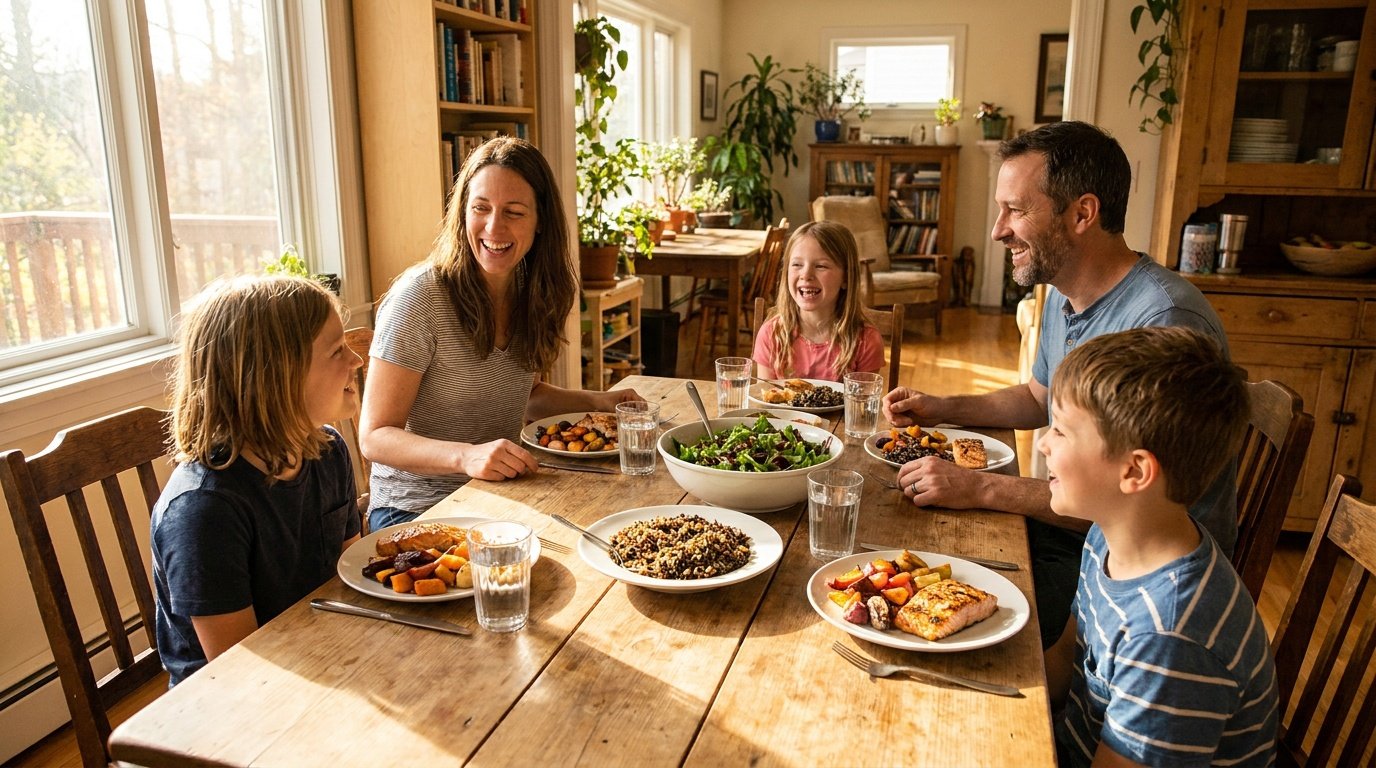
Harvard’s Healthy Eating Plate is a useful visual anchor. It’s simple. Vegetables and fruit take up the most space. Whole grains come next. Healthy proteins and fats round it out.
The NHS recommends at least 5 portions of a variety of fruit and vegetables every day. The American Heart Association says to limit sweetened drinks, processed meats, salty foods, and trans fats. Harvard says water should replace sugary beverages whenever possible. These three sources don’t agree on everything, but they agree on this.
When you’re reading a nutrition label, look for foods with less than 140 milligrams of sodium per serving. That’s a practical rule that cuts through a lot of noise fast.
The NHS also recommends 6 to 8 glasses of fluids daily, with water as the first choice.
None of this is about perfection. It’s about building a plate that covers the basics consistently. That’s the whole game at this stage.
What this is actually about is self-efficacy. A patient who can look at their plate and make one better choice — not the perfect choice, just a better one — starts to build evidence that they are someone who takes care of themselves. That is the mechanism. The vegetables and the sodium labels are just the vehicle. If the recommendations fall flat, it is usually because no one connected the behavior to the identity shift underneath it.
How to Make a Meal Plan That Actually Fits Your Life
Figuring out the balance and schedule that meets your lifestyle is often the first domino. It’s not about having a perfect plan. It’s about having a plan that you’ll actually use.
Do you consistently grocery shop and prep for the week? Do you usually meal prep, or do you prefer cooking each night? Those two questions tell you more about where to start than any food pyramid ever will.
The Mayo Clinic and CDC both recommend the same practical steps: make a list, plan meals in advance, avoid impulse purchases, and limit prepackaged convenience foods. Those foods tend to be lower in nutrients and higher in sodium, added sugar, and saturated fat.
Cooking at home is one of the most consistently recommended behaviors across every major health source.
If your schedule is tight, the substitutions don’t have to be dramatic. Grilled instead of fried. Fruit instead of fries. Smaller portions. Water instead of soda. These aren’t optimization moves. They’re just better defaults.
If this is something you are wanting to focus on, try starting with the question: “What does your week actually look like on the days where you do meet your expectations for your nutrition?”
Daily Healthy Eating Routine Example
A healthy eating day doesn’t need to be rigid. It needs a rhythm. Think about it in terms of structure, not rules.
Start with a breakfast that includes protein and some fruit or vegetables. Lunch should follow the plate model: more vegetables than anything else, a whole grain, a lean protein. Dinner is the same idea. The CDC recommends reading the Nutrition Facts label when you’re choosing packaged foods and buying minimally processed options to prepare at home whenever you can.
Are you getting adequate fruits and vegetables? Adequate protein? Are you drinking enough water? Those are the three questions worth asking yourself at the end of the day — not whether your macros were optimized.
Healthy Snack Ideas
Snacks don’t need to be complicated. Fruit over packaged snacks. Nuts over processed options. Water over sweetened drinks. A handful of carrots or celery with hummus. A piece of whole fruit. A small handful of almonds or walnuts.
The substitution principle applies here too. You’re not eliminating snacks. You’re just choosing ones that are closer to the source and further from the factory.
Where Do You Fall Into This?
Is your nutrition in alignment with your goals for your health? That’s the question worth sitting with. Not whether your diet is optimal. Whether it’s working for you.
Once the basics are ironed out, it becomes much easier to fine-tune and figure out where the gaps actually are. But you can’t fine-tune something that hasn’t been built yet. The foundation comes first.
What would be the next step of progress for you? That’s not a rhetorical question. It’s the only question that matters right now.
The gap between knowing and doing is not a knowledge problem. It never was. People know that vegetables are better than fast food. What they do not have is a version of healthy eating that fits inside their actual life — their schedule, their stress load, their budget, their kitchen. That is the real work. Building something small enough to actually happen.
If you’re not sure where your nutrition currently stands, the Daily Health Audit is the place to start. It’s free. It’s practical. And it’s built to help you figure out exactly where your first domino is.