
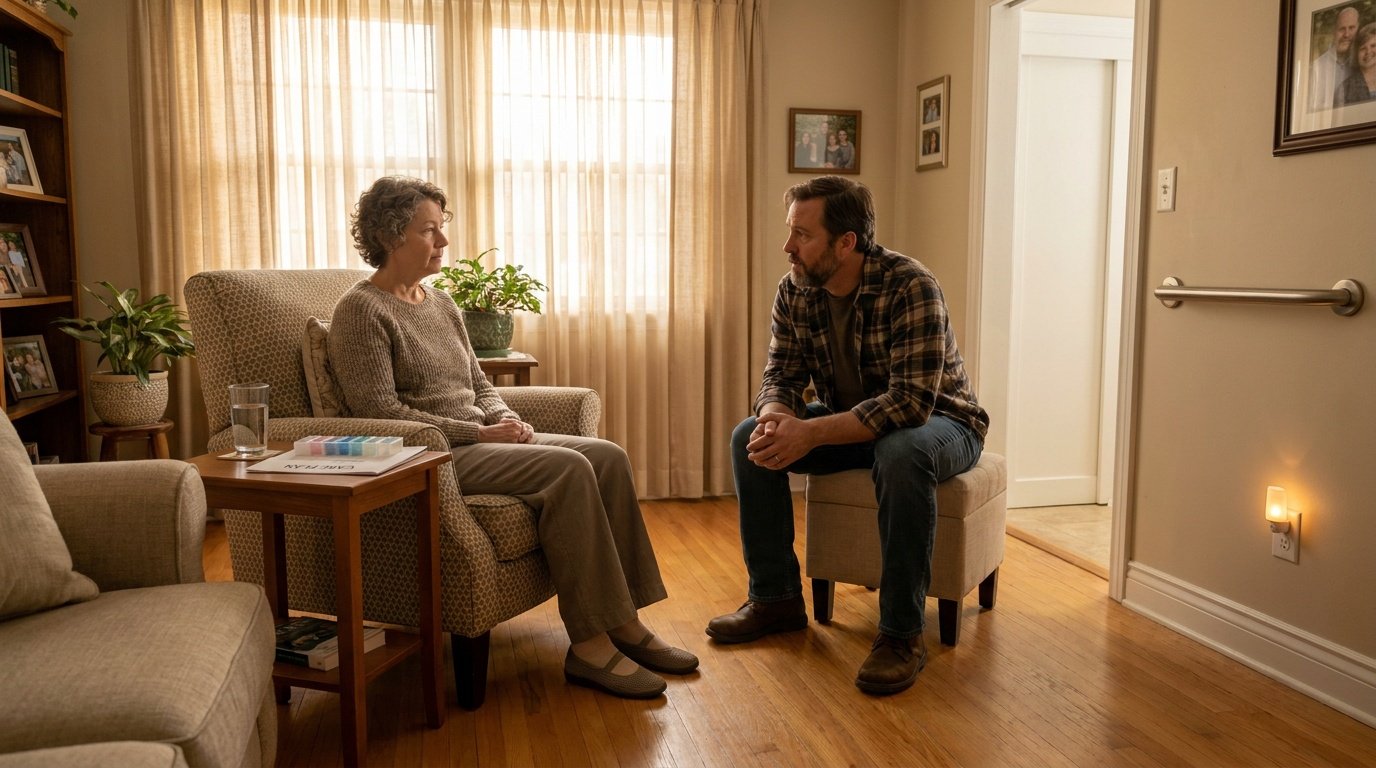
- The transition to home is the highest-risk stretch of your entire recovery, and the first 30 days are where most people fall apart or find their footing.
- A written discharge plan built with your care team before you leave the hospital is not optional. It is the road map that keeps you out of the ER.
- Home care should start within 24 to 48 hours of discharge. Waiting longer leaves a dangerous gap in your care.
- Your home has to be physically ready before you walk back through the door. Falls, missed medications, and poor sleep are the three fastest ways back to the hospital.
- Daily habits, not just discharge paperwork, are what actually keep you home. One clear task each day beats a long list of goals every time.
[Table of Contents]
What “Transition to Home” Actually Means After a Hospital Stay
The transition to home is the full process of safely moving a patient from a hospital, rehab center, or nursing home back to their own house, with a written plan, a care team, and real daily support in place before they ever walk out the door.
This is not just a discharge event. It is a window of time, usually the first 30 days home, where the risk of going back to the hospital is highest.
The first 24 to 48 hours after discharge are the most critical stretch, according to the Institute for Healthcare Improvement’s how-to guide on reducing rehospitalizations.
Three things have to happen in that window: someone from the care team meets with the patient and family before discharge, a full care check happens at the first home visit, and every provider involved is actually talking to each other.
Health Quality Ontario’s patient guide is clear that a written transition plan must be built with the patient, their family or caregivers, the hospital team, and community providers, all before the patient leaves the building.
Transitional home care, which is temporary support right after a hospital or rehab stay, has been shown to reduce the risk of being readmitted to the hospital after discharge.
Understanding the coaching process behind daily recovery support is one of the fastest ways to close that gap.
Who Needs Transition to Home Support
Not everyone needs the same level of help going home. But certain people face a much steeper climb, and knowing which group you fall into matters before discharge day.
The table below maps out who carries the highest risk and why the risk is higher for each group.
| Who | Why the Risk Is Higher |
| Seniors recovering from surgery or a fall | Slower healing, higher fall risk at home |
| Stroke patients | Physical and thinking changes affect daily tasks |
| People with multiple health conditions | More medications, more moving parts to manage |
| Anyone who lives alone | No one to catch warning signs early |
| People with no written discharge plan | No clear road map for what to do next |
| NDIS participants with complex support needs | SA Health’s Transition to Home program built five new Bright Transitional Units specifically for this group |
The patients who struggle most in the first week home are usually the ones who left the hospital with a stack of paperwork but no one clear person to call when something feels off.
That is not a paperwork problem. That is a support gap, and it is one of the most common reasons people end up back in the ER within two weeks of discharge.
Preparing the Home Before Hospital Discharge
The home has to be ready before the patient walks in, not after. Waiting until discharge day to figure this out is too late.
Walking back into a house with loose rugs, poor lighting, and no grab bars is not a minor inconvenience. It is a direct fall risk on day one.
Work through this checklist before the patient leaves the building:
Falls are one of the top reasons seniors end up back in the hospital within 30 days. The tips below address the six most common physical triggers.
- Make an appointment with your doctor before or right at discharge. Review all medications. Some cause dizziness or balance problems.
- Keep moving. Staying still makes muscles weaker fast. Light daily movement, even short walks, keeps the body stronger.
- Wear sensible shoes. No socks on hardwood. No loose slippers. Firm, closed-toe shoes with grip.
- Remove home hazards. Rugs, low furniture, and anything on the floor is a tripping risk.
- Light up your living space. Darkness is one of the biggest fall triggers at night.
- Use assistive devices. If the hospital gave you a walker or cane, use it. Every time.
Give the person going home one clear, physical task for each day of the first week. Not a list of goals. One task. That is what sticks.
Warning Signs to Watch for in the First 48 Hours Home
Most hospital readmissions happen in the first 30 days, and the first 48 hours are the riskiest stretch of all.
The signs that something is wrong almost always show up before the crisis does. The problem is that most people don’t know what to look for or how fast to act on it.
Call the doctor within 24 hours if you notice any of these:
- Fever over 100.4°F
- Swelling, redness, or warmth around a wound or surgical site
- Shortness of breath or chest tightness
- Confusion or sudden memory changes
- Pain that is getting worse, not better
- Dizziness when standing up
- No bowel movement for more than 3 days after surgery
- Trouble keeping food or water down
In rehab settings, the patients who ended up back in the hospital were almost never surprised by what happened. The signs were there a day or two earlier. They just didn’t know what to do with them.
Don’t wait to see if it gets better on its own. Call within 24 hours. That window matters.
What a Written Transition Plan Should Include
A written transition plan is not a discharge summary. It is a living road map, built with the patient, their family, the hospital team, and whoever is providing care at home, all before the patient leaves the building.
Health Quality Ontario’s quality standard states clearly that people transitioning from hospital to home must receive a written transition plan developed in partnership with the patient, caregivers, and care providers.
The table below shows every section a solid written plan must cover and what it should actually say in each one.
| Section | What It Should Say |
| Diagnosis and condition summary | What happened. In plain words. |
| Medications | Full list, doses, timing, and what each one is for |
| Follow-up appointments | Dates, providers, phone numbers |
| Warning signs | What to watch for. Who to call. |
| Daily activity limits | What the patient can and can’t do right now |
| Home care services | Who is coming, when, and what they will do |
| Emergency contacts | Doctor, specialist, pharmacy, and a backup person |
| Patient’s own goals | What matters most to the patient right now |
If the patient did not get a written plan at discharge, call the hospital’s discharge planner or social worker the same day. Ask for one in writing.
Knowing your healthy lifestyle pillars before you leave the hospital gives you a much clearer picture of what daily recovery actually needs to look like.
How Home Care Fits Into the Transition to Home Process
Home care is a clinical bridge that keeps the patient stable, catches problems early, and fills the gap between leaving the hospital and being truly back on their feet.
It is not just having someone come over. It is structured, timed support that runs parallel to the written plan.
Home health care vs. home care: what’s the difference?
- Home health care is medical. A licensed nurse or physical therapist comes to the house. They check wounds, manage medications, and run therapy sessions. This is usually covered by Medicare if a doctor orders it.
- Home care is non-medical. A home aide helps with bathing, dressing, meals, and getting around the house. This is not always covered by insurance but is often available through Medicaid programs.
When should home care start?
The IHI guide recommends the first home visit happen within 24 to 48 hours of discharge to reduce avoidable rehospitalizations. If that’s not possible, within 72 hours at the latest.
Does Medicare cover home care after a hospital stay?
Medicare Part A covers home health services if the patient is homebound, the doctor certifies the need, and a Medicare-approved agency provides the care. It does not cover 24-hour home care or non-medical personal care on its own.
What if the patient does not want home care?
This is common. Don’t force it. Start by asking what they are worried about.
Most of the time, the concern is about losing independence, not the help itself. Framing home care as short-term and goal-focused changes the conversation fast.
The patient has the answers. It may be important for someone to fit more activity into their day, but give them the chance to decide what that looks like. Ask: “What chances do you see to fit more activity into your life?” That question opens the door without pushing.
The Real Reason People End Up Back in the Hospital After Going Home
You watch someone walk out of the hospital with a folder full of papers, a medication list, and three follow-up appointments already booked. Two weeks later, they’re back.
The folder didn’t fail them. The daily follow-through did.
Here is a real example of what it looks like when the right support is actually in place. A patient came to The Public Wellness Project while recovering from a stroke, navigating one of the hardest stretches of his life.
In those early weeks, he needed support for nearly everything: walking to the bathroom, communicating clearly, getting through the day. The goal wasn’t just physical recovery. It was helping him find his footing again as a father, a husband, and a person with a sense of purpose.
What drove him from the start wasn’t a clinical milestone. It was his daughter. Reconnecting with family and friends gave him a reason to push forward even before the physical progress came, and that became the foundation everything else was built on.
Through the program, he got clear on exactly what he needed to focus on each day: building his walking, working on his sleep, managing his stress, and staying connected to the people who mattered most.
Other providers were a critical part of his care team, and The Public Wellness Project worked alongside that support to help him string it all together into daily momentum.
The moments that marked his progress were the ones that mattered to him most. Getting back to holding his daughter. Returning to his apartment in Brooklyn. Doing the stairs. Going out to dinner. Leaving the house on his own.
Now he’s rebuilding his energy and tolerance for daily life, thinking about returning to work, moving back home full time with his wife and daughter, and getting back to the role he played in their lives before. Golf, a half marathon, and a full-time job are still ahead. But the foundation is there.
His outcome came from having daily clarity, a reason that mattered to him, and a team keeping him on track. Most people who go back to the hospital don’t have those three things lined up.
I learned this the hard way working in inpatient rehab. Patients were often recovering from one of the most serious medical events of their entire lives. Motivation high. Urgency to create change even higher. Yet patients still struggled to prevent future problems going forward. On top of all the barriers around getting care, there is a gap in patient action.
The gap is not information. Everyone gets a packet at discharge. The gap is follow-through. Nobody goes home planning to fail. They just don’t have a system that keeps them moving when things get hard.
Metabolic Health and Inflammatory Conditions During Recovery at Home
Your metabolic system, which is your body’s process for turning food into energy, takes a real hit during a hospital stay, and that slows down how fast you heal once you get home.
Long hospital stays mean less movement. Less movement slows down your metabolic system. Slower metabolism means slower healing, lower energy, and a harder time keeping blood sugar steady.
Inflammatory conditions are states where your body is stuck in a constant low-level fight mode. Think of what happens with high blood pressure or diabetes: the body is already working harder than it should. When rest and poor eating pile up during a hospital stay, those conditions get worse.
Physiological reactions, which means things your actual physical body is doing, like swelling, fatigue, and pain, are often worse in the first two weeks home. This is normal. But it means the body needs steady daily support, not just one big effort.
Here is what actually helps during this stretch:
- Small meals spread through the day instead of one or two big ones
- Short walks, even 5 to 10 minutes, to keep blood moving
- Staying hydrated. Water is one of the simplest tools for keeping your body’s filters, the kidneys and liver, working right
- Sleep. This is when the body actually repairs. Poor sleep slows down every part of recovery.
Your nutrition habits in the first 30 days home matter more than most people realize. What you eat directly affects how fast your body can repair itself.
Medicaid and Financial Support for Transition to Home Services
Money is one of the first walls people hit when they get home from the hospital, and knowing what help is available before discharge makes a real difference in what you can actually set up.
Most families don’t know these programs exist until after discharge. By then, the window to apply has already narrowed. Ask the social worker before you leave the building.
The table below maps out the key financial programs, what each one covers, and where each figure comes from.
| Program | What It Covers | Source |
| New York Medicaid Community Transition Services | Up to $5,000 per person, one time only, for moving costs including security deposit, when moving from a certified care setting into your own home | New York Housing Resource Center, HRG Module 7, OPWDD 2019 Medicaid waiver |
| Medicare Part A | Covers home health visits from licensed nurses or therapists if ordered by a doctor and provided by a Medicare-approved agency | Medicare.gov |
| SA Health Transition to Home (Australia) | Provides transitional community housing and support for eligible NDIS participants, including five Bright Transitional Units for those with extremely complex needs | SA Health |
| Medicaid Home and Community-Based Services (HCBS) | Covers personal care, home changes, and some medical equipment depending on the state | State Medicaid programs |
The $5,000 New York Medicaid figure is capped at one occasion only. It does not repeat. It applies only when moving from a certified setting, such as a nursing home or group home, into your own place.
For people in Pennsylvania, the state has a formal process for transitioning from nursing home to community care, including required paperwork and specific steps to start the move. Check your own state’s Medicaid office for what applies to your situation.
How to Build Daily Habits That Actually Hold Up After Discharge
The first week home sets the tone. Not because one week changes everything, but because the habits you build or drop in that first week are the ones that either carry you forward or pull you back.
It’s a lot easier to hit the goal of “take medications at 8 AM every day” than “stay on top of your meds.” Knowing exactly what to do today beats a vague plan every time.
Here is a simple daily framework for the first 30 days home:
Morning:
- Take medications at the same time every day. Set a phone alarm.
- Eat something small within an hour of waking up. Don’t skip it.
- Do 5 to 10 minutes of gentle movement, even just walking to the kitchen and back.
Midday:
- Check in with how the body feels. More pain than yesterday? Less? Write it down.
- Eat a small meal. Don’t wait until you’re starving.
- Rest if needed. Short rest is not giving up. It is part of healing.
Evening:
- Review the next day’s appointments and medication schedule.
- Wind down screens 30 minutes before bed. Sleep quality directly affects recovery speed.
- Check the warning signs list. If something feels off, call the doctor in the morning. Don’t wait.
Weekly:
- Attend every follow-up appointment. No skipping.
- Review the written transition plan. Are you hitting the goals on it?
- Ask for help if something isn’t working. Adjusting the plan is not failing.
As patients build change, they need to build momentum and confidence around their progress. This lets them build routines and habits that actually fit into their schedule, and break free of the frame of “because my PT said so.”
Making better daily decisions is the skill that keeps every other part of recovery from falling apart.
Frequently Asked Questions About Transition to Home Services
How Soon After Discharge Should Home Care Start?
Home care should start within 24 to 48 hours of discharge, which is the window the Institute for Healthcare Improvement identifies as the highest-risk period for avoidable rehospitalization.
If same-day care is not possible, get it set up before the patient leaves the hospital. Don’t wait until they’re home and struggling to figure out who to call.
What Is the Difference Between a Home Health Aide and a Certified Home Health Aide (CHHA)?
A home health aide helps with personal tasks like bathing, dressing, and meals. A Certified Home Health Aide (CHHA) has completed a state-approved training program and can perform some basic health-related tasks under the supervision of a nurse.
CHHAs are often required for Medicaid-funded home care programs. If you’re not sure which one you need, the hospital’s discharge planner can tell you based on what the patient needs day to day.
What If My Parent Does Not Want Home Care After the Hospital?
This is one of the most common problems families face. The patient doesn’t want help. They want their life back.
Don’t lead with the word “help.” Lead with what they want. Ask what their first goal is when they get home. Then show how home care makes that goal possible faster.
Start small. One visit. Not a full schedule. Let them see it isn’t a takeover.
Should I Take Time Off Work to Be There When My Family Member Comes Home?
Yes, if you can. The first 24 to 48 hours home are the highest-risk window, and having someone physically present makes a real difference.
You don’t have to stay the whole time. But being there for the first day, helping set up medications, doing a safety walk-through of the home, and being present for the first home care visit matters a lot.
If taking time off is not possible, coordinate with a sibling, neighbor, or home care agency to cover that first window. Don’t leave it uncovered.
Every patient’s path to change looks different. What they know about themselves, and what action feels reasonable to them, will lead to more progress than making sure the most clinically correct recommendation gets delivered.
Who Would Benefit From Hospital-to-Home Transition Care Services
Transition to home support is not just for people with serious injuries. Anyone whose daily routine was disrupted by a hospital stay can benefit from structured support in the first weeks home.
The list below covers the groups that most commonly need this kind of help:
- Seniors recovering from hip or knee replacement surgery
- Anyone who had a stroke and is rebuilding daily function
- People managing heart conditions, high blood pressure, or diabetes who need help keeping habits steady after discharge
- Patients who live alone and have no one to check in on them
- Anyone who was readmitted to the hospital in the last year. That history is a strong signal that the first transition didn’t have enough support behind it.
Strong social connection is one of the most overlooked parts of recovery. People who have someone checking in on them, even informally, do better in the first 30 days home.
For families supporting a loved one through this process, transitional home care services provide a structured bridge that reduces the pressure on family members while keeping the patient safer. Family caregivers navigating a loved one’s move home often find that having a clear plan and outside support changes the entire experience.
Care Designed for a Safe Return Home: What the First 30 Days Should Look Like
You walk back through your front door and everything looks the same. But your body is not the same yet. The house didn’t change. You did.
The first 30 days are not about getting back to normal. They are about building a new normal that is strong enough to hold.
Here is how the first 30 days break down into three phases:
Days 1 to 7: Stabilize
- The body is adjusting. Energy is low. Pain may be higher than expected.
- Focus on medications, sleep, small meals, and not falling.
- Get all follow-up appointments booked if they weren’t done at discharge.
Days 8 to 14: Build
- Start adding slightly more movement each day. Not a full workout. Just a little more than yesterday.
- Check in with the written transition plan. Is it still accurate? Does anything need to change?
- If home care is in place, use those visits to ask questions, not just receive care.
Days 15 to 30: Expand
- Start thinking past survival mode. What does normal daily life look like now?
- Identify one thing the patient wants to get back to. Build toward that specifically.
- Review what’s working and what isn’t. Adjust the plan. Don’t just push through something that isn’t helping.
Whether the patient is recovering from a stroke and working to address high blood pressure to prevent future problems, or rebuilding strength after surgery, progress comes from daily changes in habits and routines that line up with what’s actually important for their health.
For seniors specifically, transitional care services designed around getting safely back home after a hospital or facility stay can cover the full range of daily support needs during this stretch.
You Just Got Home. Let’s Make Sure You Stay There.
The transition to home is the hardest stretch of recovery. You have the discharge papers. You have the medication list. But having a real person in your corner, someone who helps you figure out exactly what to do each day and keeps you on track when things get hard, is what actually closes the gap.
That’s what we do at The Public Wellness Project.
Take the free Daily Health Audit. It takes a few minutes. It gives you a clear picture of where your daily habits stand right now and where the biggest gaps are. No fluff. Just clarity.
Technical Deep-Dive & Clinical FAQs
Why is the 24 to 48 hour post-discharge window clinically significant for rehospitalization risk?
The first 24 to 48 hours after discharge represent the period when medication errors, missed follow-up contacts, and undetected wound complications are most likely to go uncaught, because the formal clinical safety net of inpatient monitoring has been removed before the home care safety net is fully in place.
The Institute for Healthcare Improvement’s how-to guide on improving hospital-to-home transitions identifies this specific window as the highest-risk stretch and recommends three concrete actions: an in-hospital meeting with the patient and caregivers before discharge, a full care assessment at the first home visit, and active communication coordination across all providers involved in the care plan.
How does a hospital stay affect the metabolic system and why does that slow recovery at home?
Prolonged bed rest during a hospital stay reduces muscle activity, which directly slows the metabolic system, your body’s process for turning food into energy, and lowers insulin sensitivity, making it harder for cells to use glucose efficiently.
This metabolic slowdown compounds with inflammatory conditions, which are states where the body is running a constant low-level fight response, like what happens with high blood pressure or diabetes, and together they increase fatigue, slow tissue repair, and make it harder to maintain steady energy through the day during early home recovery.
What is the clinical difference between home health care and non-medical home care, and how does Medicare coverage apply to each?
Home health care is a skilled medical service, meaning it is delivered by a licensed nurse, physical therapist, or occupational therapist who performs clinical tasks like wound assessment, medication management, and therapeutic exercise under a physician’s order.
Non-medical home care covers personal assistance tasks like bathing, dressing, and meal preparation, and while it is not covered under Medicare Part A on its own, it may be covered through state Medicaid Home and Community-Based Services waivers depending on the patient’s income, functional status, and state of residence.
What does the New York Medicaid Community Transition Services stipend actually cover and who qualifies?
The New York OPWDD 2019 Medicaid waiver Community Transition Services stipend covers one-time moving costs for individuals transitioning from a certified setting, such as a nursing home, group home, or other institutional care facility, into their own home or apartment, with a hard cap of $5,000 per person inclusive of security deposit.
This benefit is available on one occasion only and does not renew, meaning it cannot be used a second time if the person later returns to institutional care and transitions again, so timing the application before or at the point of discharge from the certified setting is critical.
Why do inflammatory conditions get worse after a hospital stay and what daily habits directly counter that?
During a hospital stay, reduced movement, disrupted sleep, poor nutritional intake, and the physiological stress response to illness or surgery all increase markers of inflammation, which means the body’s own fight response stays elevated even after the acute event is over.
Short daily walks of 5 to 10 minutes improve blood flow and help lower inflammatory markers, small frequent meals stabilize blood sugar and reduce metabolic stress, and consistent sleep, which is when the body repairs at the cellular level, is the single most powerful daily tool for bringing the body’s fight response back down to a normal level during home recovery.
What makes a written transition plan different from a standard hospital discharge summary?
A standard hospital discharge summary is a clinical document written by the provider for the provider, summarizing the patient’s diagnosis, treatment, and medical history in technical language intended for the next clinical team to read.
A written transition plan, as defined by Health Quality Ontario’s quality standard, is a living document built with the patient, their family or caregivers, the hospital team, and community providers before discharge, written in plain language, and covering not just medical history but daily activity limits, warning signs, follow-up appointment dates, home care service details, and the patient’s own goals for recovery.