
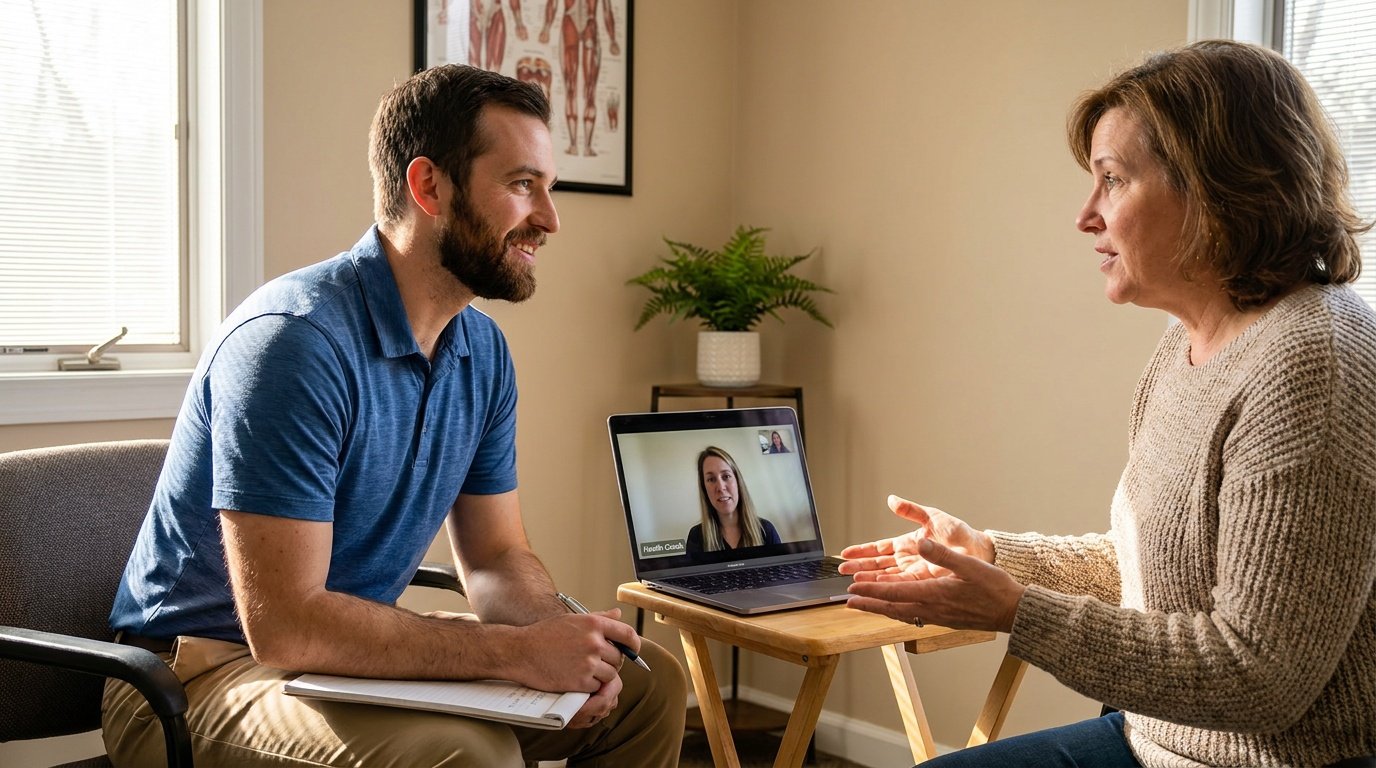
The field keeps trying to solve engagement with better content delivery. More handouts, cleaner portals, shorter videos. What that misses is that most patients who disengage aren’t confused — they’re exhausted. The assumption I had to unlearn early was that activation follows information. It almost never does. Activation follows a moment where the patient feels like the plan was built for their actual life, not a clinical ideal of it.
What Is Patient Engagement?
Patient engagement is when a patient actively takes part in understanding, managing, and staying connected to their own care. It’s not the same as compliance. Compliance is provider-imposed. Engagement is patient-driven.
The strongest themes in the current evidence base are clear communication, shared decision making, digital tools, and ongoing follow-up. Those four things show up across almost every major review on this topic. That’s not a coincidence.
The distinction between engagement and compliance matters before you read a single strategy below. If you skip past it, the tactics won’t land the way they should.
Why Is Patient Engagement Important in Healthcare?
Medical providers often feel like they’re working to fit a square peg into a round hole. No amount of educating and motivating the patient seems to get the person to change. They might be right.
The problem isn’t that patients don’t know what changes they need to make. A lot of people already know. It’s just difficult to find the time and energy to make it their reality. The barrier is activation, not information.
The NIH evidence base on this is substantial. Researchers identified 134 systematic reviews on patient and family engagement strategies. 126 of those focused specifically on direct patient care.
The number that hit me wasn’t the scale of the evidence — it was what it implied about how long this problem has been documented without changing clinical default behavior. I’ve sat with patients who knew exactly what they needed to do. The chart note from their last three providers said the same thing. What none of those notes captured was the moment in the appointment where the patient decided it wasn’t worth saying what they actually needed. That’s the gap the research keeps circling. It’s not a knowledge problem. It’s a trust problem, and it starts inside the fifteen-minute visit.
Engagement directly affects adherence, chronic condition management, and long-term health behavior. When it works, patients don’t just follow a plan. They own it.
10 Best Strategies to Improve Patient Engagement
1. Start With the Patient’s Self-Knowledge
The first move isn’t education. It’s excavation. In coaching, we call this prospering off of the patient’s self-knowledge. The patient has the answers.
The provider’s job is to fill in the gaps and provide support and insight along the way. That’s it. The answers aren’t coming from the clipboard.
Three questions that open this up in a real clinical conversation:
- How have you made changes in the past?
- What do you need to be successful?
- What do you need to change or sacrifice for this to happen?
Those aren’t intake questions. They’re the actual work.
I used to open with a question that sounded open-ended but wasn’t — something like “how has it been going with your home program?” That question has a right answer baked into it, and patients know it. The first time I asked someone what they actually needed to be successful and then waited — really waited — the answer surprised me. She didn’t need more instruction. She needed permission to start smaller than the protocol called for. The 88-review finding tells me that moment isn’t unique to my practice. It keeps happening everywhere providers ask instead of tell, and the field still hasn’t made that the default.
2. Use Technology to Improve Patient Engagement
Digital tools are among the most commonly studied engagement interventions in chronic conditions. Patient portals, text-based outreach, and mobile health apps lower the friction between visits. They extend the human connection rather than replace it.
Technology only works when it meets the patient where they already are. A portal a patient never logs into isn’t an engagement tool. It’s a filing cabinet.
The shift to digital is about continuity. What happens between appointments matters just as much as what happens during them.
3. Start Engagement Before a Patient Visit
Pre-visit reminders, intake preparation, and expectation-setting reduce no-shows and increase in-visit efficiency. Engagement isn’t a single touchpoint. It’s a cycle: pre-visit, in-visit, post-visit, and continuous.
Automated pre-visit outreach combined with segmented messaging by patient need is the practical pattern that shows up consistently across the evidence. It works because it signals to the patient that the system is already paying attention before they walk in the door.
That signal matters more than most providers realize.
4. The Power of Personalized Patient Communication
Teach-back is non-negotiable. Confirm understanding. Don’t assume it. Multiple communication options — texting, portal messaging, phone — should reflect patient preference, not provider convenience.
Personalization means meeting patients on their preferred channels and accounting for access barriers. Start with something familiar first. Build momentum and confidence before layering in anything new.
Before trying to do the recommended workout from your provider, try something you already enjoy first. Is that a walk with a friend or shooting hoops in the driveway with your daughter? Get your mojo back first, and then work to build in the new stuff.
“What’s something you’re already doing — even inconsistently — that you feel good about when you do it?” That question doesn’t create the agenda. It finds the thread that’s already there. What the patient names is almost always the right starting point, and it’s almost never what you would have picked for them.
5. Drive Patient Participation With Shared Decision Making
Shared decision making is the second most studied engagement strategy in the NIH evidence base. Thirty-four systematic reviews focused on it directly. That’s not a fringe idea. That’s a core finding.
The provider’s role here isn’t the authority delivering instructions. It’s the guide filling in gaps. Shared decision making works because it honors what the patient already knows about their own life. Don’t get stuck trying to make the plan perfect. Start with something familiar and build momentum.
6. Automate Patient Engagement Without Losing the Human Signal
Automation handles the operational layer: reminders, check-ins, follow-up sequences. The 48-hour post-visit window is critical. Automated summaries and check-ins during this period reduce drop-off in a measurable way.
Automation frees providers to focus on the relational and coaching work that actually drives behavior change. Segment patient populations so automated messages stay relevant. Generic messages are noise. Relevant ones are a signal that the system sees the patient as an individual.
7. Deliver Seamless Omnichannel Patient Support
Patients don’t live in one channel. Engagement strategy shouldn’t either. Consistent care managers across touchpoints build trust and reduce confusion.
Proactive check-ins — not just reactive responses — signal to patients that the system is paying attention. That’s a different experience than waiting to be contacted only when something goes wrong.
Continuity across channels is what makes the whole system feel like a system rather than a series of disconnected appointments.
8. Engage Patients Through Educational Content and Health Insights
Education activates. Information alone does not. The goal of patient education is patient activation — moving someone from passive recipient to active participant.
Tie educational content to the patient’s own goals and self-identified barriers. Not just clinical benchmarks. A patient who sees themselves in the content is a patient who actually reads it.
The content isn’t the intervention. The activation is.
9. Truly Personalize Engagement
Segmentation is the operational version of personalization. Group patients by need, risk, and preference. That’s the floor, not the ceiling.
True personalization goes deeper. It accounts for what a patient values, what has worked for them before, and what they’re willing to sacrifice. That’s where Luke’s three questions come back in — not just as an intake ritual, but as a personalization framework you return to across the care relationship.
What often gets in the way for you when creating changes in your life? That question belongs in every conversation, not just the first one.
10. Gather Actionable Insights Through Patient Surveys and Continuous Measurement
Engagement isn’t a one-time intervention. It requires monitoring over time. Key metrics include the Patient Activation Measure (PAM), patient retention rate, and patient satisfaction scores.
Measurement closes the loop. What gets tracked gets improved. Portal login rates, message response rates, and appointment adherence are operational signals that tell you whether the system is actually reaching people between visits.
The feedback loop is what turns a set of tactics into a functioning strategy.
All of it comes down to one thing: the patient has to be the main character in their own care, not a recipient of someone else’s plan. Every tactic on this list is just a different way of returning authorship to the person who has to live with the outcome. When that’s missing, even the best-designed intervention fails.
Patient Engagement Challenges and How to Address Them
The square-peg-round-hole problem is real. Providers exhaust themselves educating patients who already know the answer. The energy is going to the wrong place.
Common barriers aren’t ignorance. They’re time, energy, access, and competing life demands. The gap between knowing and doing is not an information gap. It almost never is.
When motivation tactics aren’t working, the reframe is simple: stop trying to deliver the answer and start asking better questions. The provider’s role shifts from teacher to guide. That shift is harder than it sounds, but it’s where the actual clinical leverage lives.
What often gets in the way for you when creating changes in your life? That question isn’t rhetorical. It’s the most direct path to understanding what a patient actually needs from the care relationship — and it’s the question most clinical conversations never get to.
Addressing engagement challenges means accepting that the patient is the primary agent of change. The provider’s job is to support that process, not own it.
How to Measure the Impact of Patient Engagement Strategies
The Patient Activation Measure (PAM) is the gold standard for gauging a patient’s knowledge, skill, and confidence to manage their own health. It’s not a satisfaction survey. It measures readiness and capacity.
Patient retention rate works as a proxy for sustained engagement. If patients keep coming back, something in the relationship is working. If they’re dropping off, the measurement tells you where to look.
Patient satisfaction scores are outcome signals, not vanity metrics. Operational signals matter too: portal login rates, message response rates, appointment adherence. These tell you whether the system is reaching people between visits or just during them.
The feedback loop is what separates a strategy from a list of tactics. Measurement informs segmentation. Segmentation sharpens personalization. Personalization improves activation. That cycle is the whole game.
Putting Together a Patient Engagement Strategy That Works
The coordinated cycle is pre-visit, in-visit, post-visit, and continuous improvement. No single tactic works in isolation. The strategies work best together, not as a menu you pick from.
The through-line across every tactic in this list is the same: it only works if it starts from what the patient already knows about themselves. The three self-knowledge questions aren’t a nice-to-have opener. They’re the foundation the rest of this sits on.
For providers ready to put this into practice: start with those three questions before layering in any digital or operational tool. The technology amplifies the relationship. It doesn’t replace it.
The patient knows best. The provider’s job is to help them trust that.
People don’t fail to change because they lack information or willpower. They fail because the care system keeps handing them plans designed for a version of themselves that doesn’t exist yet. The work worth doing is building the conditions where the patient can become that person — and that starts the moment you decide your job is to ask better questions, not deliver better answers.
Take the Patient Motivator Questionnaire
Providers already doing the work of patient engagement deserve a sharper tool for understanding what actually motivates each patient. The Patient Motivator Questionnaire is the operational bridge between the strategies outlined above and real clinical application. It’s built to surface the self-knowledge your patients already have — so you can stop guessing and start meeting them where they actually are.
Take the Patient Motivator Questionnaire
Author: Luke Alley, PT, DPT — Doctor of Physical Therapy and Health and Well-Being Coach, The Public Wellness Project